Oviposition site selection and egg clutch survival in the Emerald glass frog (MS defense)
For egg-laying organisms, choosing the right spot for their offspring is critical. Female frogs that lay eggs outside of the water face a particular challenge: their eggs are vulnerable to predators, drying out, and other risks until they hatch. We wanted to know whether mothers are making decisions about where they lay, and whether those choices make a real difference for their offspring's survival.
I studied how oviposition substrate influences embryo survival in the Emerald glass frog (Espadarana prosoblepon), a species in which females deposit eggs on multiple substrates, providing a rare opportunity to test how oviposition decisions affect reproductive success. Monitoring clutches in the wild, I compared microclimatic conditions, hatching success, and sources of embryo mortality between the most commonly used substrates: spike moss (Selaginella diffusa) and leaves.
Additionally, I conducted a two-choice experiment in semi-captivity to test whether females preferentially select one substrate over the other. Although microclimatic conditions did not differ between substrates, hatching success was significantly higher on S. diffusa, which also experienced less predation. In the two-choice experiment, all females laid their eggs on S. diffusa, and those clutches had higher hatching success and faster embryonic development rates than those on leaves. Together, these results support the hypothesis that non-random oviposition site selection in E. prosoblepon is driven by the maximization of embryo survival, demonstrating that substrate choice has measurable fitness consequences for the offspring.
Thesis Committee
- Dr. Johana Goyes Vallejos (Chair)
- Dr. Kevin Middleton
- Dr. Rex Cocroft
Sebastian would like to continue his studies of the behavior and ecology of Neotropical frogs. In the future, he intends to pursue a PhD focused on parental care behavior in frogs.
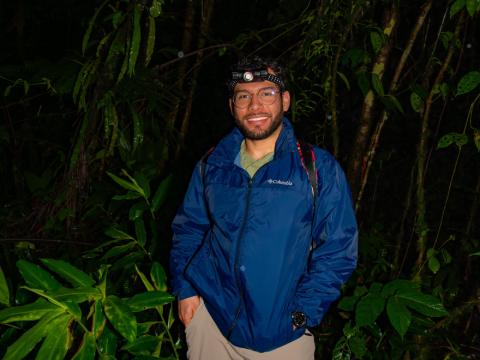
Sebastián Curaca Fierro
Graduate Student - Goyes Lab
Division of Biological Sciences
University of Missouri