Thesis Defense: The effect of social interactions on the vocal behavior of a glass frog
Acoustic communication is fundamental to social interactions in many animal species, allowing individuals to transmit information about identity, reproductive status, and competitive ability. In anurans (frogs and toads), vocal signals play an essential role in behavior, being especially important in mating and species recognition. Because call production is energetically costly, individuals may modify their calls based on the social context (e.g., alone or in a group) to increase communication efficiency. While context-dependent variation in frog calls has been explored in several taxa, it remains largely understudied in glass frogs (Family Centrolenidae).
I investigated how social context influences acoustic signaling in the emerald glass frog, Espadarana prosoblepon. This species provides an excellent system to examine how individuals modulate their signals in response to dynamic social environments. By combining detailed behavioral field observations with quantitative acoustic analyses, I characterized the vocal repertoire of males and examined how call properties vary across distinct social scenarios.
My work approached this question from multiple angles. First, I identified the social contexts in which males vocalize and defined call types associated with these contexts. I then used multivariate analyses to quantitatively validate field-based classifications of call types. Finally, I used generalized linear mixed models to compare acoustic properties across validated social contexts and assess how call characteristics differ between contexts.
We found that E. prosoblepon modifies multiple acoustic properties depending on the social context. Specifically, males produced longer and louder advertisement calls when calling near other males than when calling alone. Courtship calls contained more notes and were louder than other call types, whereas aggressive interactions were characterized by pulseless, low-frequency, and soft calls.
By demonstrating context-dependent modulation of vocal signals in a glass frog, this work highlights the importance of the social environment in shaping communication strategies. More broadly, it provides a framework for integrating natural history, behavior, and quantitative analyses to better understand the evolution and function of acoustic communication in anurans and other animal systems.
Thesis Committee
- Dr. Johana Goyes Vallejos (chair)
- Dr. Manuel Leal
- Dr. Rex Cocroft
Next steps: Natalia Mejia will be continuing her research in the Goyes Lab as a doctoral student.
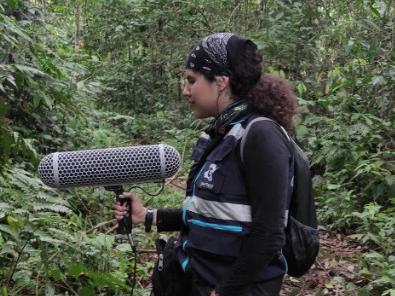
Natalia Mejia
Graduate Student
Division of Biological Sciences
University of Missouri