Translational Regulation and Metabolic Control of Amino Acid Homeostasis in Arabidopsis and Maize Seeds (Dissertation Defense)
Cereal grains are a primary source of dietary protein worldwide, yet their nutritional quality is limited by deficiencies in essential amino acids (EAAs), largely due to the composition of seed storage proteins (SSPs). Efforts to improve seed protein quality are complicated by proteome rebalancing, a compensatory process in which reductions in SSPs are offset by broader changes in the seed proteome that maintain overall protein-bound amino acid composition. Despite its importance, the regulatory basis, environmental stability, and broader biological context of this process remain incompletely understood. In Chapter 1, I synthesize existing literature on seed protein composition, amino acid regulation, and proteome rebalancing to define key knowledge gaps, particularly the lack of mechanistic insight into how protein composition is maintained and whether this buffering is robust across conditions.
In Chapter 2, I investigate the molecular basis of proteome rebalancing in maize and identify previously uncharacterized components of the translational machinery associated with this process, revealing a central role for TOR signaling in coordinating proteome remodeling—an aspect not described in maize to date. This finding establishes a mechanistic link between nutrient signaling and seed protein composition. These analyses revealed extensive remodeling of translation-associated components across seed development, including changes in proteins associated with the Target of Rapamycin (TOR) pathway.
Chapter 3 extends this analysis to Arabidopsis thaliana to test the robustness of proteome rebalancing under environmental stress to further uncover the molecular mechanism. Using wild-type and the SSP-deficient cruabc mutant across varying nitrogen and water conditions, I show that seeds consistently maintain amino acid composition within each environment, indicating a stable homeostatic endpoint. However, the underlying metabolic and proteomic responses differed across treatments, with distinct shifts in redox state, carbon metabolism, and translation-related processes, suggesting that multiple physiological routes can converge on a similar compositional endpoint.
In Chapter 4, I placed these findings within a broader systems context by analyzing the plant translational apparatus across tissues, developmental stages, and species. A cross-species, multi-omic analysis in Arabidopsis, maize, and rice showed that most translation-related components are maintained near baseline abundance, consistent with a conserved core program. However, a subset exhibited reproducible tissue- and stage-specific variation across transcriptomic and proteomic datasets. Seeds displayed distinct and dynamic translational signatures across compartments and developmental time. These patterns mirror the remodeling observed in Chapters 2 and 3, placing proteome rebalancing within a broader, conserved yet context-dependent translational landscape.
These findings position translational regulation as a key axis underlying amino acid homeostasis and a promising target for improving seed protein composition. Future work should define the causal roles of TOR-linked pathways and specific components of the translational machinery, test their stability across environmental conditions, and translate these insights into strategies for crop biofortification.
Publications
Ansaf H, Bagaza C, Yobi A, Mawhinney TP, and Angelovici R. Environmental stress reveals new insights regarding proteome rebalancing in Arabidopsis thaliana seeds. Plant J. 2026:126(2):e70881.
Ansaf H, Yobi A, and Angelovici R. Amino acid quantification from maize tissues. Cold Spring Harb Protoc. 2025:2025(12):pdb.top108440.
Duong HN, Ansaf H, Cornish P, Mendoza-Cozatl D, Schenck C, and Angelovici R. Rapid and robust polysome isolation and fraction RNA extraction for studying the seed translatome. Curr Protoc. 2024:4(9):e70007.
Doctoral Program Committee
- Dr. Ruthie Angelovici, Chair
- Dr. David Braun, Co-Chair
- Dr. James Birchler
- Dr. Bing Yang
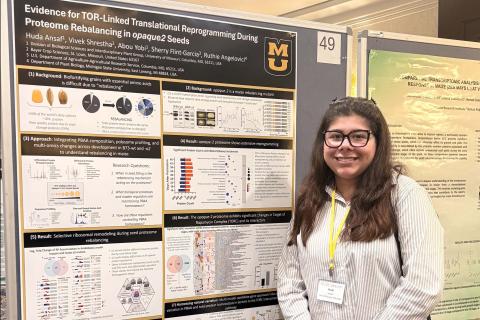
Huda Ansaf
Ph.D. Candidate
Division of Biological Sciences
University of Missouri